
Digital connectivity
China’s government has long considered the internet essential infrastructure to upgrade its industry, boost competitiveness and for potential military uses. A combination of industrial policy, protectionism and entrepreneurship have led to the establishment of important telecommunications companies – chief among them, Huawei.
China was an early mover in 5G, currently the most modern mobile connection to the internet. Huawei and ZTE took part in early standardization meetings on 5G, and China deployed 5G in 2018, before most Western countries started their roll-out. Huawei’s technology rivals that of established equipment suppliers Nokia and Ericsson and is usually cheaper.
Now, the world is watching 6G, for which 2025 will be an important year. Huawei is already set to play an important role in this future key technology.
China’s strategy of building infrastructure first, assuming demand will follow, has worked very well especially in mobile and broadband internet. In disruptive internet technologies, this strategy is not possible. For instance, Chinese companies still trail the US satellite internet provider Starlink, which pioneered low Earth orbit (LEO), high-bandwidth satellite internet. China launched the first satellites in 2024 for Qianfan, an eventual globe-spanning internet network to rival Starlink, one of three networks intended to be operational in China by 2025.
Other technologies have seen less innovation in recent years but are still a focus of US-China tech competition. Submarine communications cables, for instance, have an average life cycle of 17 years, with recent innovation mostly focused on cost effectiveness. Since most traffic passes through submarine cables, both the US and China are wary about spying, and have thus competed for the location and control of many of these cables.


Graphics dashboard
US’s Starlink still dominates the satellite market around the world

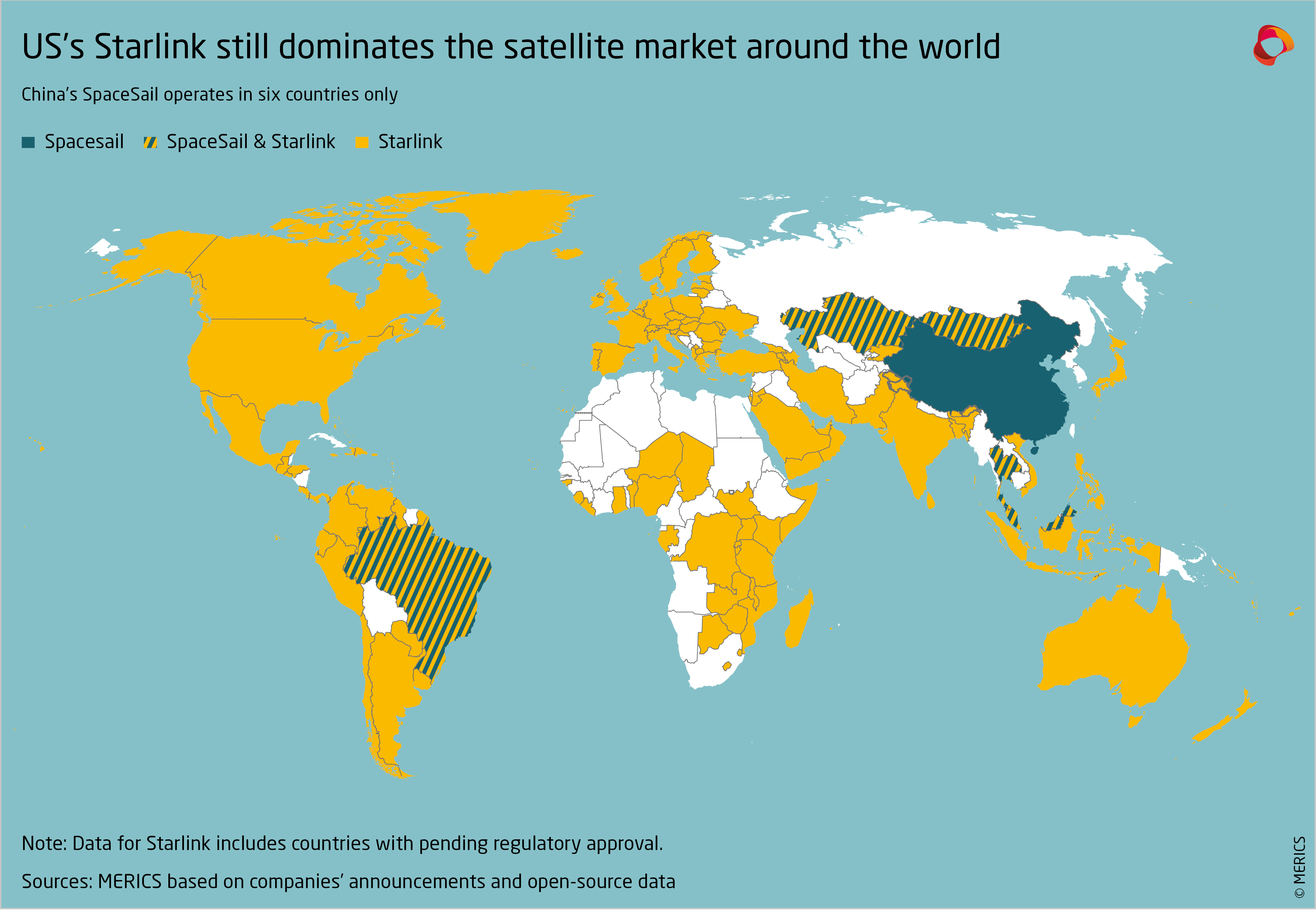
China is hoping to compete with US SpaceX’s Starlink, which operates in over 120 countries. Chinese provider SSST, which operates the SpaceSail constellation and is currently active in only six countries, aims to expand to at least 30 more by the end of this year, 2026. At the moment, no Chinese satellite internet provider can deliver broadband speeds to even a small number of users worldwide, though China is set to launch a huge number of internet satellites in the coming years.
China speeds up launches despite hurdles

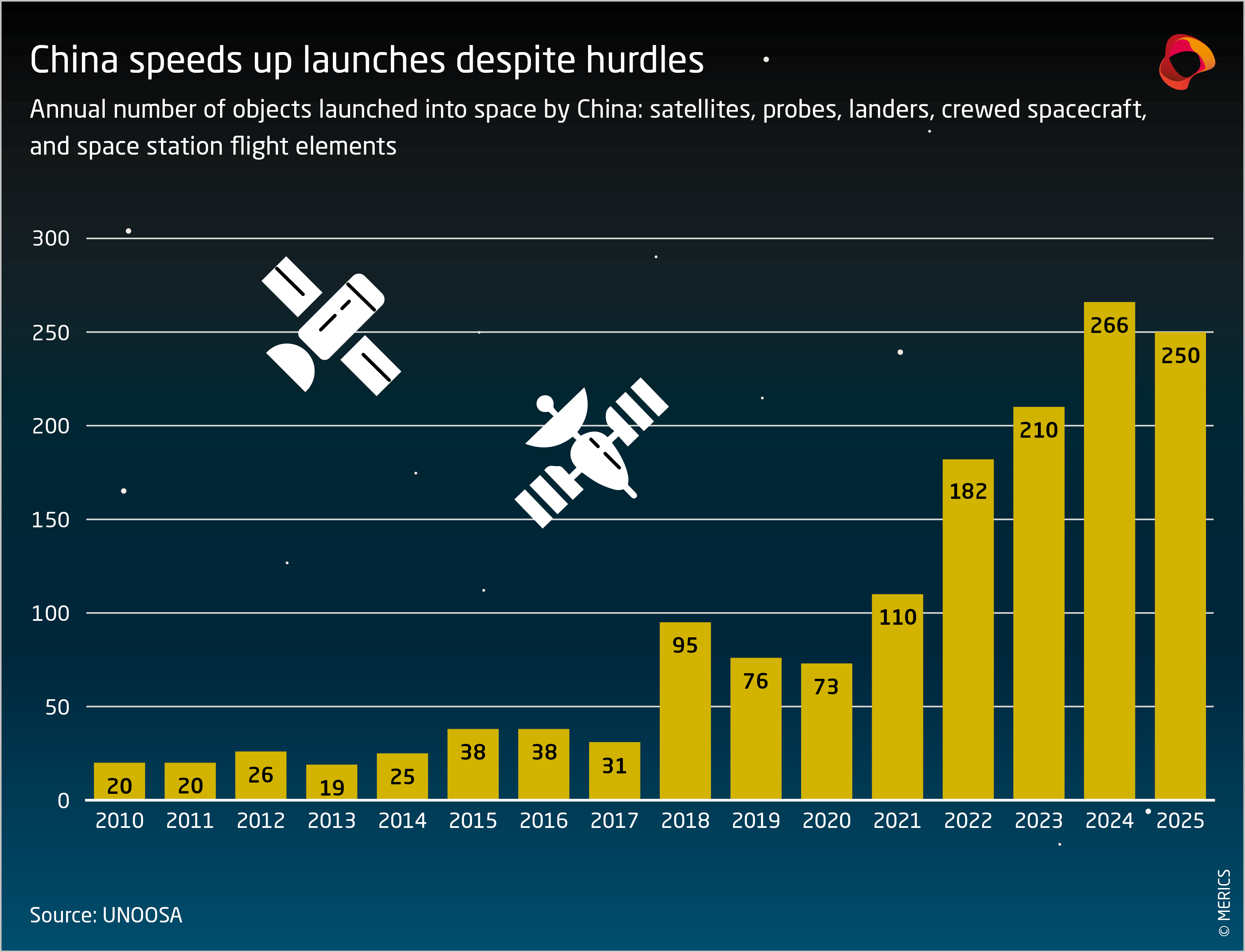
China is accelerating its space launches despite structural, operational, and technological constraints. Between 2018 and 2022, China had a higher number of successful launches than any other country. This started with the construction of the Beidou satellite navigation system, with ten Long March rockets placing 18 satellites.
The US dominates launches around the world

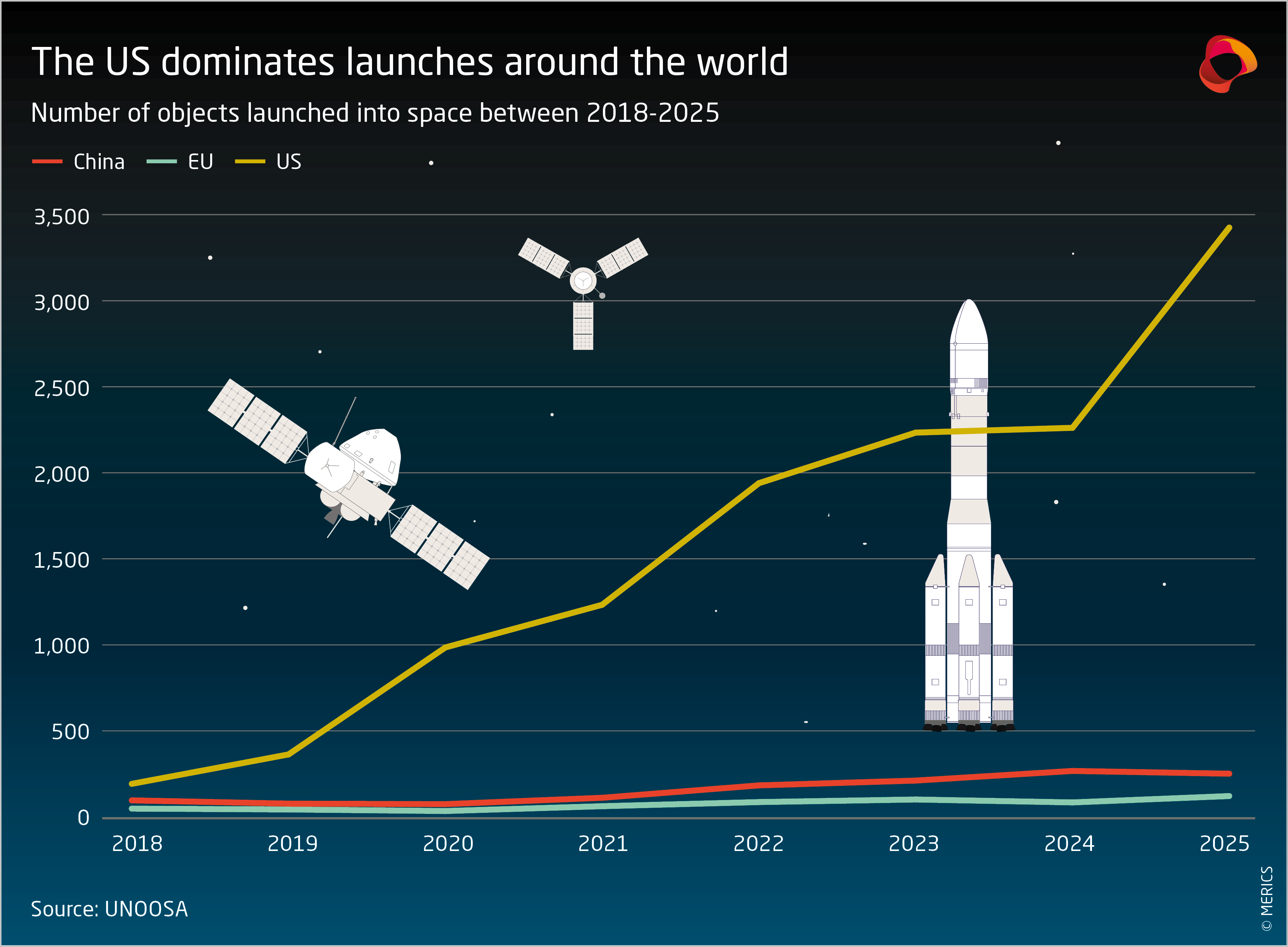
The US dominates space launches and especially launched objects globally, in part due to reusable, high-capacity rockets like SpaceX’s Falcon series. China still relies on single-use Long March rockets with limited payload capacity. Without access to reusable, high-capacity rockets, China faces major challenges in scaling mega-constellations like its SpaceSail and Guowang to meet International Telecommunications Union requirements.
Digital Connectivity in China: Timeline of crucial events
Development
Policy/regulation
China's Big Three state-owned telecommunication operators (China Mobile, China Unicom and China Telecom) launch 5G networks in China, almost nine months before the launch of 5G in Europe.
Oct 2019
China establishes the SOE China Satellite Network Group (SatNet) to drive the internet satellite megaconstellation GuoWang (China Satellite Network), China's state megaproject for satellite internet.
Apr 2021
NDRC launches "Eastern data, Western computing" megaproject to make China’s computing power infrastructure more efficient &sustainable, moving data processing to inland provinces with cheaper land.
Feb 2022
Huawei presents 5G-Advanced (also called 5.5G) at the Mobile Broadband Forum in Doha. 5G-A is an innovation between 5G and 6G. Huawei was the first to develop a complete product portfolio for 5.5G.
Oct 2023
National Research Centre of Parallel Computer Engineering and Technology (Wuxi) discloses details on supercomputer Sunway OceanLight, built despite US sanctions, may be one of three exascale machines.
Dec 2023
China Mobile conducts the world's first low earth orbit (LEO) satellite test using 6G technology, driving forward its plans for an integrated terrestrial-space network with high speed and low latency.
Feb 2024
A team from Beijing University of Posts and Telecommunications says it has built the world's first 6G field test network, an important step toward commercialization which Beijing wants by 2030.
Jul 2024
The Aerospace Information Research Institute completes China's first operational satellite-to-ground laser communication ground station - a step toward overcoming the data bottleneck for space assets.
Sep 2024
Chengdu Guoxing Aerospace Technology and its partners announce "Star Computing Plan," aiming to build a global integrated space-ground network of 2,800 satellites and over 100 ground centers.
Nov 2024
Commercial satellite company Chang Guang Satellite Technology sets a data transmission speed record of 100 gigabits per second – 10 times faster than its previous feat less than a year earlier.
Jan 2025
Beijing elevates 6G to a national strategic priority in the annual government work report, targeting commercialization around 2030.
Mar 2025
China kicks off construction of an experimental computing power internet, aiming to interconnect diverse computing resources. It will enable, among others, on-demand access to power AI applications.
May 2025
China’s SpaceSail launches its 6th batch of satellites for a total of 108 satellites in orbit, but hasn’t met its envisioned 648 satellites due to manufacturing and launch capacity issues.
Oct 2025
China launches a School of Space Exploration to integrate education, science, technology, and talent cultivation for major national space goals.
Jan 2026

China submits two spectrum allocation filings to the UN’s International Telecommunication Union (ITU), revealing plans for a megaconstellation of ca. 13,000 internet satellites.
Sep 2020
The powerful Central Commission for Cybersecurity and Informatization publishes Beijing’s most important strategic blueprint for the digital transformation, the 14th Five-Year Plan (2021-2025).
Dec 2021
Second Institute of China Aerospace Science and Industry Corporation (CASIC) tests real-time wireless transmission using terahertz technology, important for 6G achieving 100Gbps on a 10GHz bandwith.
Apr 2023
Details emerge about the supercomputer Tianhe Xingyi (Tianhe-3), developed by the National University of Defense Technology despite US export restrictions. May be it is the world's most powerful.
Nov 2023
China has 3.2 million 5G base stations, 87 percent of the goal set in the 14th FYP. At the end of 2021, the EU-27 had only 256,000 base stations, according to the EU's 5G Observatory.
Dec 2023
Shanghai Lanjian Hongqing Technology Company (link to private rocket maker Landsoft) files with ITU to launch Honghu-III, a network of 10,000 satellites, might be the third Chinese megaconstellation.
May 2024
China launches first satellites for SpaceSail megaconstellation.
Aug 2024
MIIT launches the first batch of "5G+ Industrial Internet" pilot cities, including Nanjing and Wuhan, to accelerate large-scale application of 5G in industrial internet.
Nov 2024
The first batch of GuoWang satellites goes into orbit.
Dec 2024
To boost slowing 5G deployment, MIIT issues a “5G+industrial internet” plan for 10,000 5G factories and announces large-scale projects to boost 5G+ adoption in the healthcare sector.
Jan 2025
Zhejiang Lab launches the first phase of a constellation of “computing satellites” for in-orbit data processing, a spaced-based network with 100 satellites planned by 2027.
May 2025
China’s NDRC releases a roadmap for AI-driven urban governance in over 50 smart cities, integrating government databases, expanding IoT sensing networks, and upgrading ICT infrastructure.
Oct 2025
China files an ITU application for 203,000 satellites to expand its space programs. The new Institute of Radio Spectrum Utilization and Technological Innovation holds 95% of the applications.
Jan 2026
Recent developments
- China filed an ITU application for 203,000 satellites to expand its space programs, mostly driven by state and commercial actors. The new Institute of Radio Spectrum Utilization and Technological Innovation (无线电创新院) holds 95 percent of the applications, with the rest coming from Shanghai Spacecom (SpaceSail), China StarNet (Guowang), and China Mobile. (Source (CN): STDaily, January 11, 2026)
- The NDRC, together with the National Data Administration (NDA) and other ministries, released a roadmap for smart cities. The plan targets over 50 cities for full digital transformation by 2027. It requires them to build AI models for disaster and infrastructure monitoring, integrate data across state agencies, and expand digital services. (Source (CN): NDRC, October 31, 2025)
- After a seven-month pause, the Shanghai-backed mega-constellation SpaceSail (千帆) launched 18 satellites in October 2025, bringing the total to 108 SpaceSail satellites in orbit. The project is behind schedule (aiming for 648 satellites in 2025 and over 10,000 by the 2030s) due to challenges in manufacturing and launch capacity. (Source (CN): Innovation Academy for Microsatellites (CAS), October 17, 2025). [See also our latest CTO report “Orbital geopolitics: China's dual-use space internet” by Altynay Junusova, Rebecca Arcesati, and Antonia Hmaidi]
Digital connectivity in China: Profiling the actors

Publications


Topics