
Green technology
Over the past two decades, China has become the global leader in manufacturing green technologies. It occupies dominant positions in the supply chains for solar, wind, batteries, and new energy vehicles. As the largest investor in related manufacturing capacity, China accounted for three-quarters of investment in clean technology production in 2023.
In the eyes of Chinese policymakers, green technologies serve the twin purposes of stimulating economic growth and facilitating the country’s decarbonization. Products such as solar panels and batteries drive growth in exports, and China is investing heavily in its own renewable energy capacity.
Estimates suggest China will account for almost 60 percent of new renewable capacity installed globally between 2023-2028.
Robust market competition and state support have bolstered China’s green tech industries. Private firms such as LONGi, Mingyang, CATL and BYD demonstrate the important role of entrepreneurs in the sector’s success. However, the Chinese government has also provided significant financial support and a home market advantage to local players.
Foreign countries benefit from cheap imports of green technologies, but China's dominance also poses strategic risks. Overdependencies increase the likelihood of China exerting economic coercion and the potential for costly supply chain disruptions. Competition from China also undermines Europe’s industrial ambitions in green technologies.


Graphics dashboard
China caught up with Europe in environmental technology patents
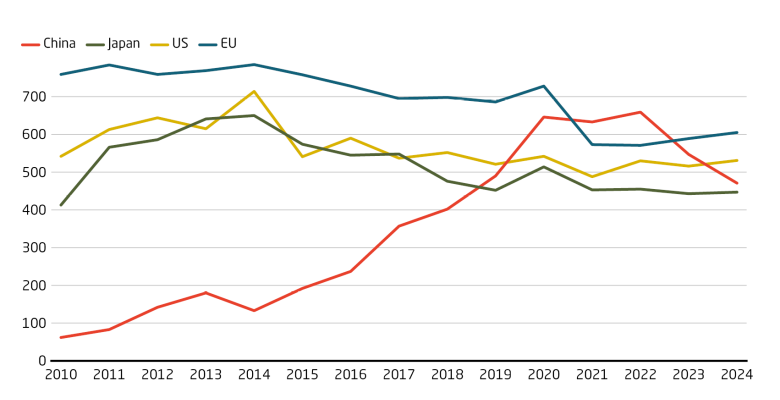
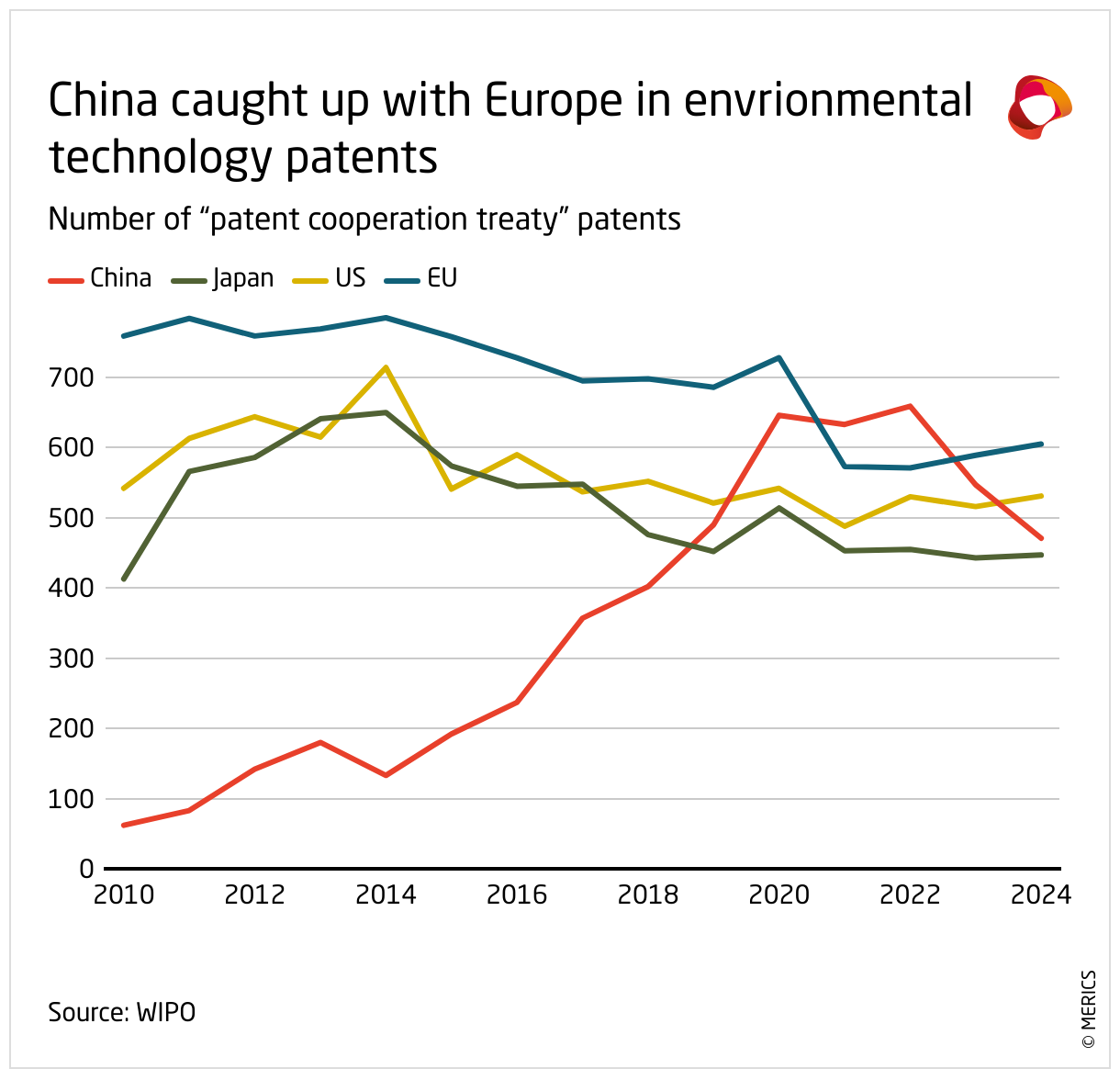
China’s internationally registered invention patents in environmental technologies rose sharply between 2010 to 2020, mirroring its rise in the sector. The number of patents has dipped since 2022, but remains on par with the EU, the US, and Japan. At the same time, China became the largest manufacturer and exporter of renewable energy equipment globally. This suggests that innovation in China is slowing down as the sector matures.
Solar installations reached a record high in 2024
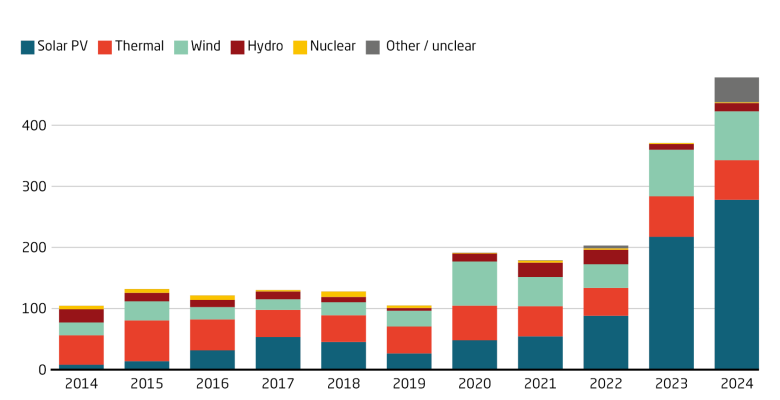
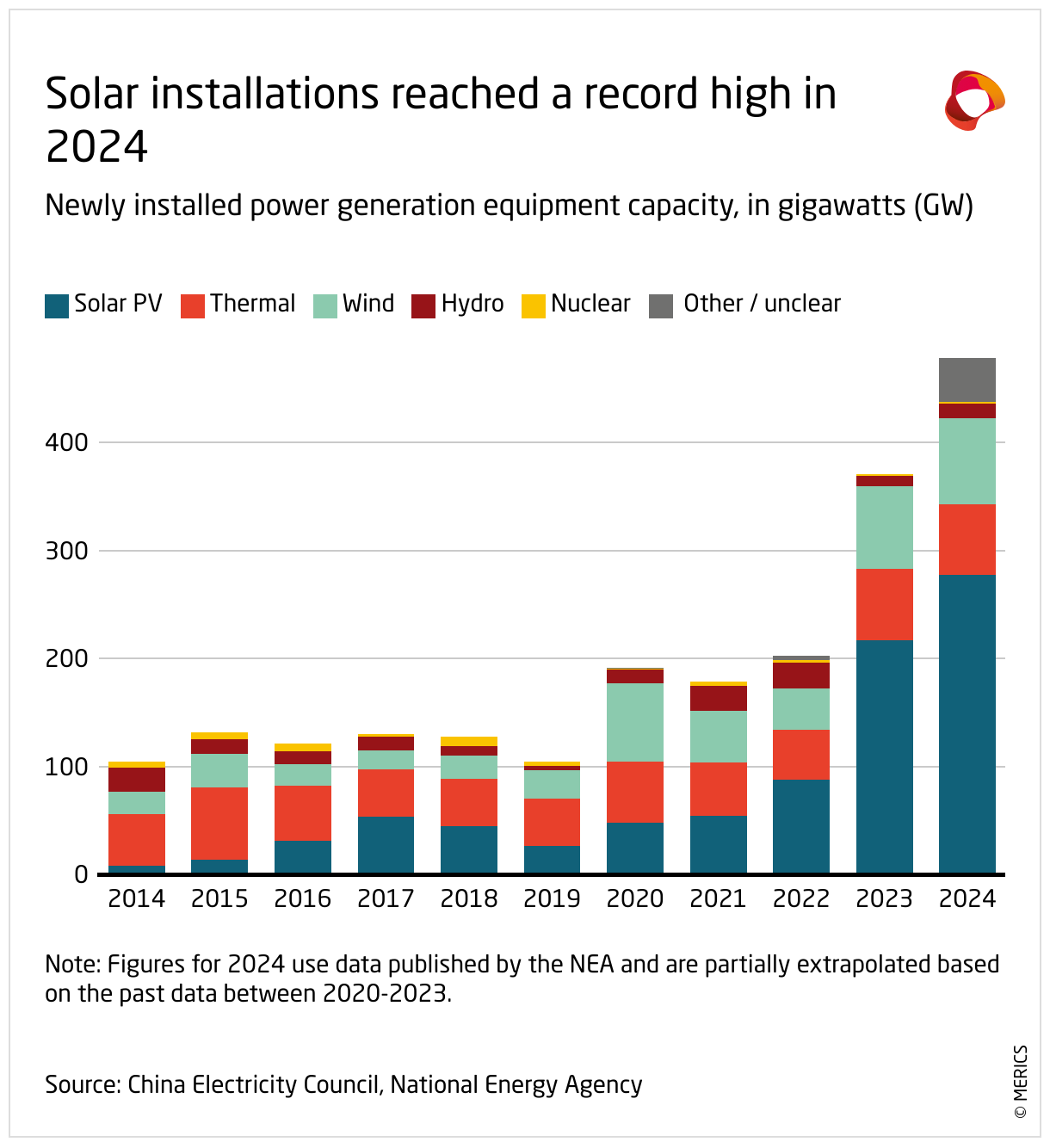
China’s solar PV installations grew at breakneck speed in 2022 and 2023 due to a drop in prices and increases in government backing. While growth has slowed, reflecting a large established base, the country more than tripled its annual new installations of wind and solar capacity in 2024 compared to 2021 and reached its target of installing 1,200 GW of wind and solar capacity by the end of 2024.
NEV and solar cell output in China has surged in recent years
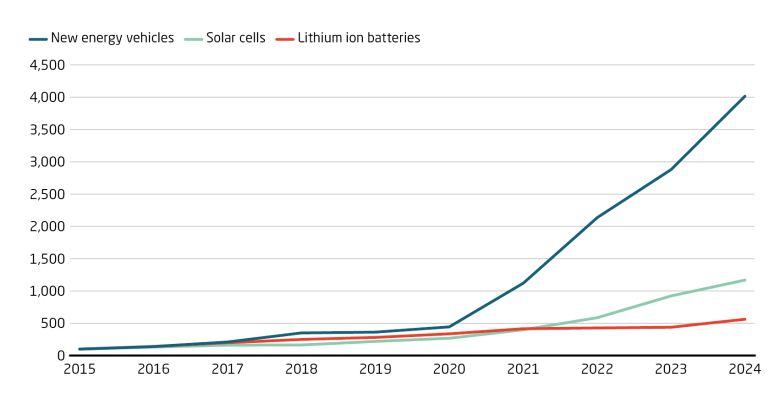
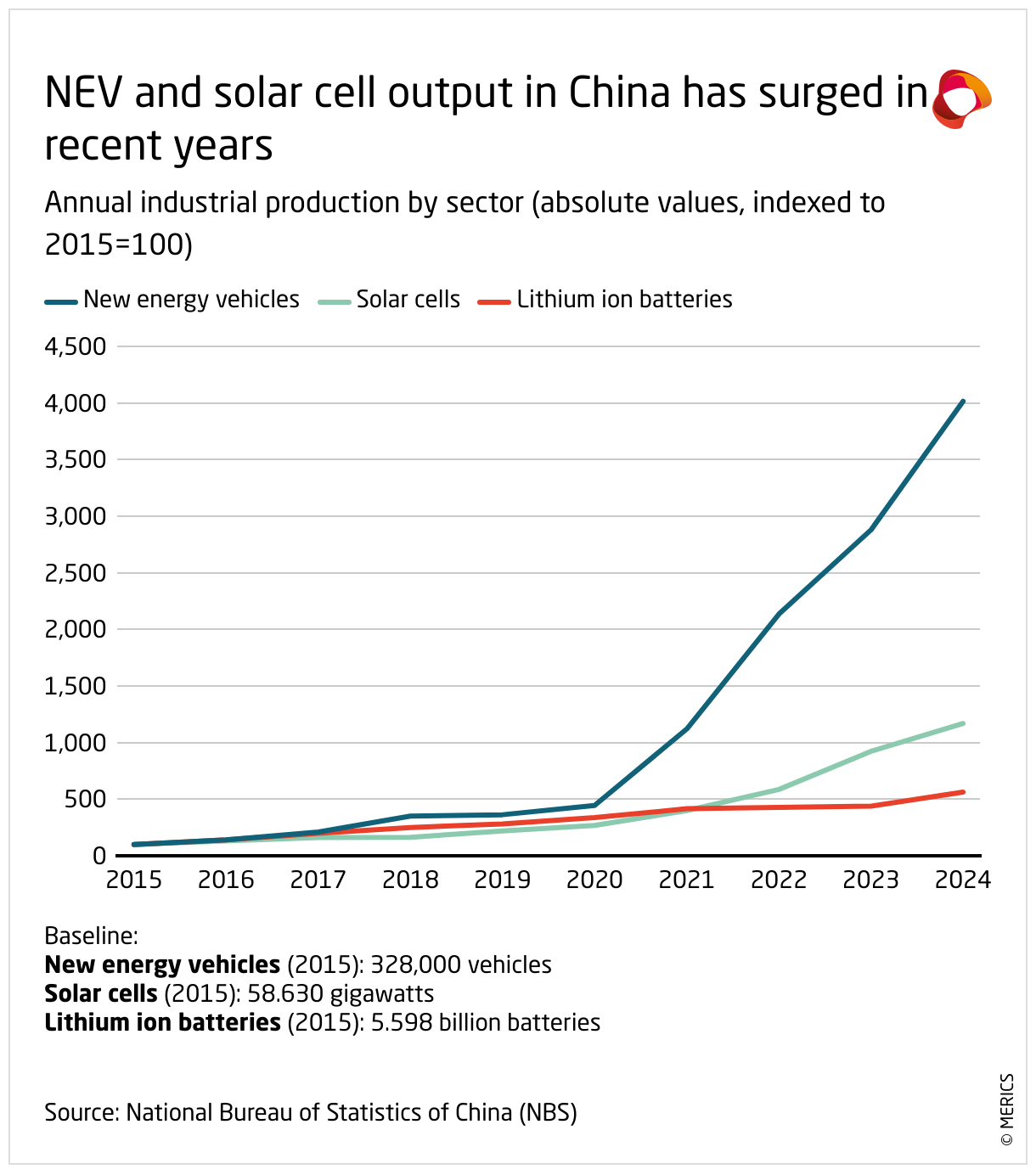
Green technology output, in particular new energy vehicles (NEVs), has grown considerably thanks to growing demand, partly driven by government support for low carbon industries. Between 2020 and 2024, the number of NEVs made in China grew from 1.5 million to 13 million, accounting for 40.9 percent of all cars produced in the country.
Green technology in China: Timeline of crucial events
Development
Policy/regulation
China Society of Automotive Engineers releases the Energy Saving and NEV Tech Roadmap 2.0, aiming for new energy vehicles (NEVs) to comprise 50 percent of new car sales by 2035.
Oct 2020
China implements a nationwide carbon trading market, starting with the power sector. Initially covering 4.5 billion tons of CO2, it is now the biggest carbon market worldwide.
Jul 2021
China’s renewable energy capacity exceeds 1,000 gigawatts – an energy transition milestone. Renewables make up 44.8 percent of capacity, with hydropower the largest at 37 percent of all renewables.
Dec 2021
The NDRC releases the 14th Five Year Plan for renewable energy. Renewables will make up at least half of electricity generation capacity added in 2021-2025. The plan aims to double solar and wind.
Jun 2023
Sinopec completes China's largest green hydrogen plant in Kuqa, Xinjiang, using photovoltaic power. It will reduce CO2 emissions by 485,000 tons annually by replacing hydrogen from natural gas.
Aug 2023
China’s largest electric vehicle maker BYD says it will build a car factory in Szeged, Hungary. Its first in Europe, the plant is expected to create thousands of local jobs.
Dec 2023
Wind and solar energy capacity surpasses coal for the first time. Non-fossil sources now make up over half of total capacity. But coal still comprised 60 percent of power generated in 2023.
Jun 2024
China’s State Council Information Office declares aim to reach a 2030 carbon peak target and 25 percent non-fossil energy consumption share. Meanwhile, energy demand has reached 1000 kWh per capita.
Aug 2024
Trina Green Hydrogen (天合元氫) begins constructing a 1GW electrolyze production line in the Yangzhou Comprehensive Bonded Zone. This facility represents China’s latest foray into green hydrogen.
Oct 2024
China Southern Power Grid’s total installed capacity over five provinces, including wind and solar, reaches 202 million kilowatts, or 36.6 percent of the total installed capacity in the region.
Feb 2025
China has increased its green hydrogen production capacity to 125,000 mt/year. It now accounts for 50% of global capacity. The National Energy Administration (NEA) plans for further development.
Apr 2025
China's installed wind and solar power capacity reaches 1,482 GW, surpassing its thermal power capacity (1,451 GW) for the first time, according to NEA data.
May 2025
UAE-based company Autocraft signs a USD 1-bn purchase agreement with China's Shi Technology for 350 E20 electric vertical take-off and landing (eVTOL) aircrafts - China's largest single eVTOL order
Jul 2025
Shipments from Tesla Inc.’s Shanghai factory are again declining, with an 8.4% decrease from 2024. Meanwhile in July, overall sales of EVs and hybrids in China grew by 25% to 1.18 m units.
Aug 2025
China’s rare earth magnet exports to the US drop 28.7% month-on-month in September amid trade tensions, threatening critical supply chains for strategic industries.
Oct 2025
The People’s Bank of China raises re-lending for tech innovation and transformation to CNY 1.2 trn, creates a CNY 1 trn re-lending facility for private firms, and launches green overseas-debt pilots.
Jan 2026
Referring to military-civilian dual-use risks and Japan’s stance on Taiwan, China tightens reporting requirements for rare earth exports to Japan, demanding detailed supply chain data.
Jan 2026
Chinese automaker BYD’s first chartered cargo ship “BYD Explorer No.1”, the first domestically built cargo ship to export Chinese cars, departs for Europe.
Jan 2026

Firms led by state-owned China Energy Investment Corp. Ltd create a CNY 10 billion (EUR 1.3 billion) fund for new energy technologies &projects, encompassing solar, wind &hydrogen-based technologies.
Jan 2021
Xi Jinping says China aims to reach peak carbon emissions by 2030 & carbon neutrality by 2060. The 2060 target is ten years later than the G7, EU, South Korea & Brazil and 10 years earlier than India.
Sep 2021
The National Development and Reform Commission (NDRC) releases a strategy to develop the hydrogen sector by 2035, focusing on the transport, energy storage, power and industrial sectors.
Mar 2022
The government extends its 2014 tax exemption policy to promote EVs. EV sales are exempt from the vehicle purchase tax until the end of 2025, and must only pay half until the end of 2027.
Jul 2023
Ningbo Shanshan, the world's largest supplier of electric car battery materials says it will build a new plant in Finland. The plant will serve Western and Central Europe.
Sep 2023
People’s Daily reports: In 2023 Chinese shipbuilders received over half of all global orders for low carbon &pollution ships. An official says China will pursue policies to support green shipbuilding.
Apr 2024
The Ministry of Industry and Information Technology issues draft rules that raise the capital ratio for solar PV manufacturing projects and need plants to operate at least 50% of annual capacity.
Jul 2024
China has surpassed 10 m total EV charging points, a milestone that signifies its early and continual state-led development of the EV industry.
Aug 2024
The MIIT issues a plan for the large-scale use of green hydrogen in metallurgy, synthetic ammonia, synthetic methanol and refining, and its application in other sectors by 2027.
Dec 2024
Saudi Arabia and the UAE have become new markets for large-scale energy storage projects by Chinese firms. BYD Energy Storage signs a 12.5 GWh battery storage project with Saudi Electricity Company.
Mar 2025
The NEA releases its first guidance on the development of virtual power plants (VPPs), which aggregate and distribute green energy, aiming for 20 million kw by 2027 and 50 million kw by 2030.
Apr 2025
China’s largest green hydrogen ammonia integration project has launched its first phase in Chifeng, Inner Mongolia, with an annual output of 320,000 tons of green synthetic ammonia.
Jul 2025
State-owned China Huaneng Group and Dongfang Electric Corp. announce a prototype for a floating offshore wind turbine capable of generating 17 MW of electricity, highlighting Chinese-made components.
Aug 2025
Upon the European Commission’s investigations into Chinese suppliers over subsidies, German company Lucara plans to substitute wind turbines from China’s Ming Yang Smart Energy with Siemens turbines.
Aug 2025
17 major silicon material companies merge into a consortium to tackle involution after China’s solar power production capacity had exceeded demand by over twofold for nearly two years.
Nov 2025
China’s PCG Power and UK’s Octopus Energy form a joint venture, Bitong Energy, to trade renewable energy in China, aiming for an output of up to 140 TWh and profits of around GBP 50 m/year by 2030.
Jan 2026
China extends anti-dumping duties on solar-grade polysilicon imports from the US and South Korea, with company-specific tariffs ranging from 55.3-57% for the US and 4.4-113.8% for South Korea.
Jan 2026
Recent developments
- The European Commission opened an in-depth anti-subsidy investigation on February 3 into Chinese wind-turbine maker Goldwind, citing preliminary findings that the company may have received Chinese state subsidies such as tax breaks and below-market-rate financing that are causing distortions in the EU market. (Source (CN): EET, February 4, 2026)
- China's Ministry of Industry and Information Technology (MIIT) launched a 2026 pilot to expand hydrogen energy use. The initiative promotes accelerating hydrogen adoption in transportation and industry, supports regional city clusters, and sets an average cost target of less than CNY 25 per kilogram. (Source (CN): MIIT, March 6, 2026)
- China released new guidelines to push harder for energy conservation and carbon reduction. These include controlling fossil fuel consumption by accelerating the reduction of coal use, curbing new oil consumption, and integrating energy conservation policy into industrial capacity planning. (Source (CN): gov.cn, April 23, 2026)
- Researchers at Tianjin University and their partners developed an organic lithium-battery cathode that enables flexible pouch cells to operate from −70°C to 80°C. This improves the cells' safety and commercialization prospects. According to the researchers, the material paves the way for future “green batteries” and new energy storage options for flexible electronics and wearable devices. (Source (CN): STDaily, February 20, 2026)
- Four US-based subsidiaries of Chinese EV maker BYD are suing the Trump administration to reclaim tariffs paid since April 2025. They assert that the government did not have the authority to impose tariffs under the International Economic Emergency Powers Act as it had claimed. (Source (CN): EET, February 11, 2026)
Publications


Topics