
Quantum
Quantum technologies are emerging as a key subject of global power competition due to their potential military applications and ability to fundamentally transform people’s lives. Quantum effects can overcome limitations of digital technologies, solve computational problems that take impossibly long using traditional computers and transmit information over long distances without the risk of being intercepted. China hopes quantum technologies will allow it to leapfrog Western rivals.
China and the US are locked in a tight race for supremacy in quantum technologies. Through sustained government investment, China has achieved a number of firsts, including developing and launching the first quantum satellite, Micius.
While China has so far led in quantum communication, which enables secure communication over long distances, the US still leads in quantum computation.
China’s quantum technology development is a major result of mission-driven innovation. In the US, private companies like IBM dominate the race. So far at least, Chinese quantum technology companies and researchers have relied on government funding. Instead of large digital companies, startups founded by people with university affiliations, and usually funded by local or central government funds, dominate the landscape.
Quantum technologies are also a major area of international collaboration. Micius, the quantum satellite, was developed in cooperation with the University of Vienna, with future communication tests taking place between China and Russia. Many quantum technologies are still far from being market-ready but could provide decisive advantages to a military using them. As such, quantum research is at the forefront of discussions about research security in Europe.


Graphics dashboard
China ramps up investment in quantum as a "future industry"


China is showing renewed interest in quantum technologies, ramping up its investment to a total of CNY 3.2 billion in the first three months of 2026, exceeding the total for all of 2025. This comes after China named quantum as a “future industry” in its 15th Five-Year Plan. After a period in which big Chinese tech companies like Baidu and Tencent scaled back or opted out of quantum investment, large- scale capital is now flowing back into the sector, suggesting a renewed focus on moving the technology from the lab to commercial applications. Compared with other future industries such as 6G or nuclear fusion, quantum is attracting strong investment momentum.
China has built the world's largest quantum communication network
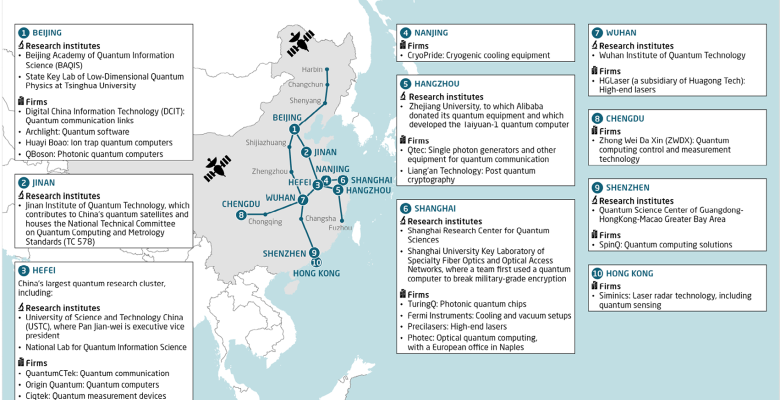
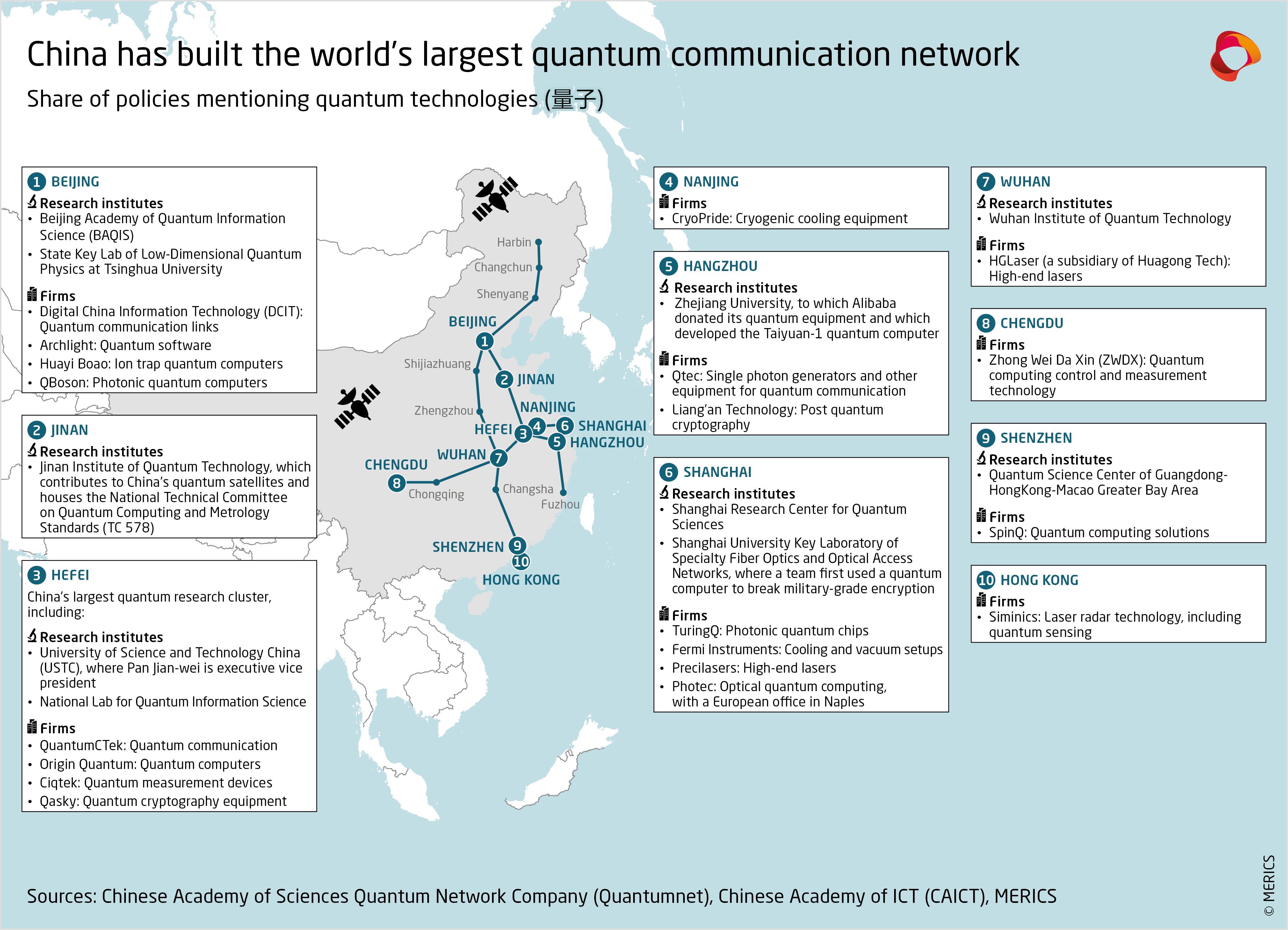
China completed the first phase of a large state-led project on quantum secure communication in 2020. It is the largest such network in the world by far, with an overall length over 12,000 kilometers and nodes in most major Chinese cities. Additionally, two quantum satellites link up the extremes of the network. Major research institutes and firms are concentrated around the network, illustrating close ties between research, state and industry.
China's policies mention quantum technology more often
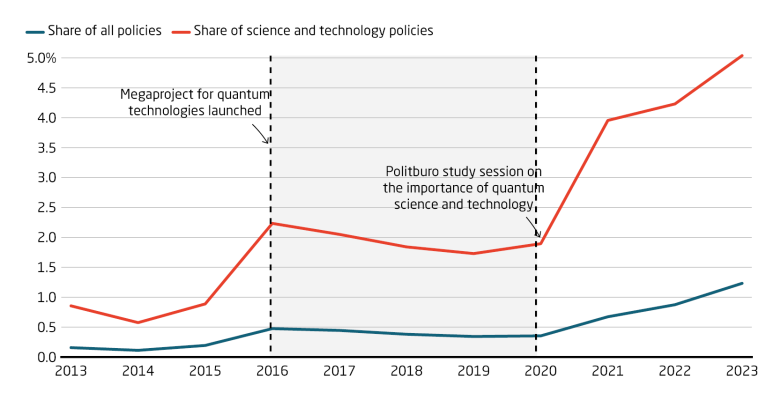
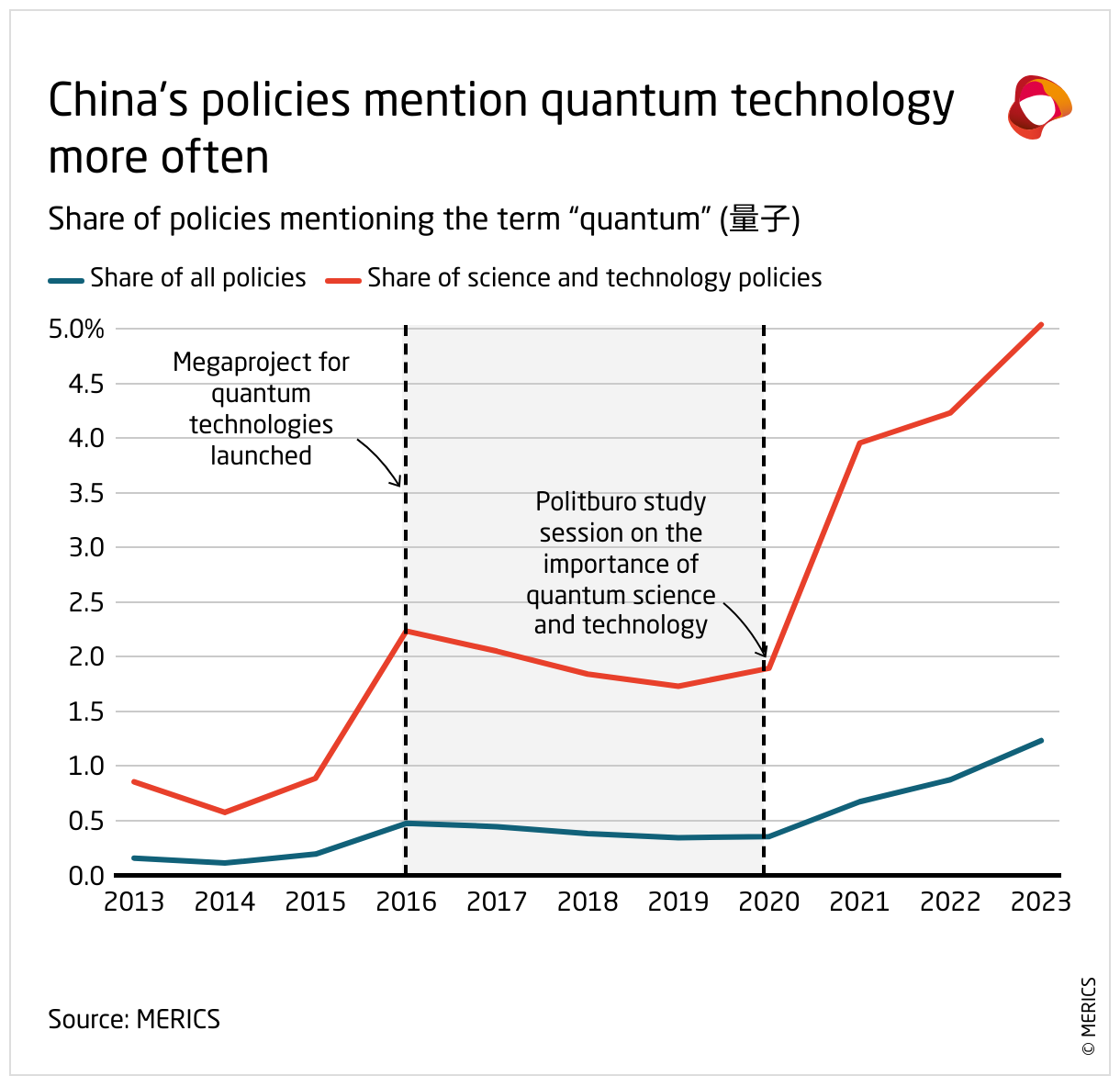
Chinese policies and regulations show an increase in mentions of “quantum” (量子) even before the launch of the megaproject for quantum technologies in 2016. The Politburo declared quantum an important front in the global S&T competition in 2020, triggering a surge in official documents mentioning the term. Mentions of “quantum” even outpaced those of “science and technology”. This illustrates how the technology has gained importance for China’s leaders.
Quantum in China: Timeline of crucial events
Development
Policy/regulation
First A-listing of a quantum firm in China at the Shanghai Stock Exchange. The firm, QuantumCTek, offers quantum key distribution services for secure communications.
Jul 2020
The US adds QuantumCTek to its Entity List of trade-restricted companies, cutting off access to key US technology.
Nov 2021
China launches its second quantum satellite, Jinan 1, a successor to Micius, the first quantum satellite in the world. These satellites allow secure communication over long distances.
Jul 2022
The MIIT issues “Implementation opinions for future industries,” detailing goals for quantum computing.
Jan 2024
Origin Quantum presents the 24-qubit quantum computer Wukon. Some of the machines used to create it are reportedly German.
Feb 2024
The International Organization for Standardization (ISO) in Stockholm accepts China’s proposal to explore a communication network security protocol that could resist decryption by a quantum computer.
Oct 2024
The US adds China’s QuantumCTek to its Entity List of trade-restricted companies, cutting off access to key US technology.
Nov 2024
State-owned China Telecom becomes largest shareholder of QuantumCTek, China’s leading firm in quantum key distribution. Its investments signal further industrialization of quantum communication.
Jan 2025
In the context of new industrial policies in areas such as biomanufacturing and quantum technology, three government departments issue joint plan to enhance financial services in quantum technology.
Mar 2025
Shandong Province speeds up efforts to become a quantum tech and industry hub by building a “first-class scientific and technological innovation ecosystem.”
Apr 2025
White Paper “National Security in the New Era” describes quantum as key for China’s technological self-reliance, calls it a “double-edged sword” in a scientific revolution alongside AI and biotech.
May 2025
Pakistan and China sign a MoU to collaborate in quantum technology, with China Electronics Technology Group Corporation helping establish Pakistan’s National Centre for Quantum Computing.
Oct 2025
China deploys a superconducting quantum computer, developed by China Telecom Quantum Group and QuantumCTek and based on the “Zuchongzhi 3.0” design for commercial use.
Oct 2025
To integrate quantum encryption into telecom networks, China Telecom reportedly completes a first successful hollow-core optical fiber transmission test of quantum and classical signals over 101.6 km.
Nov 2025
The People’s Liberation Army claims to be testing over 10 quantum warfare weapons for military intelligence, navigation, air-defense and processing large amounts of battlefield data.
Jan 2026

Researchers at the University of Science and Technology (USTC) in Hefei claim their photonic quantum computer Jiuzhang, using 76 photons, beats traditional computers (quantum supremacy).
Oct 2020
Origin Quantum becomes China’s first unicorn (startup worth more than USD 1 billion) in quantum technology. Its founders came from the Chinese Academy of Science in Hefei.
Nov 2021
China’s dedicated technical commission on quantum standards (TC578) issues its first national standard in quantum communication.
Aug 2023
China and Russia successfully establish quantum communication over a distance of 3800 km, using China's quantum satellite. Earlier experiments had been conducted with Austria.
Jan 2024
The US adds 22 Chinese organizations and firms to its Entity List, including Origin Quantum, USTC, and several CAS institutes. They can no longer import US-made technology.
May 2024
A Chinese research team successfully demonstrates a 7 km, non-local quantum gate in Hefei, opening possibilities for distributed quantum computing.
Oct 2024
Quantum is becoming a commercial industry, suggests a white paper by the Chinese Academy of ICT, a think tank under the Ministry of Industry and Information Technology.
Dec 2024
Hefei University of Science and Technology claims that the quantum computer prototype Zuchongzhi-3 is 15 orders of magnitude faster than the fastest supercomputer on current quantum benchmarks.
Mar 2025
A team at the University of Science and Technology of China presents a new quantum chip, Zuchongzhi 3.0, with 105 qubits, breaking a record for quantum computing previously held by Google.
Apr 2025
State-supported start-up Origin Quantum launches the fourth generation of its autonomous quantum computer measurement and control system Tianji 4.0.
May 2025
China launches a 2030 action plan to strengthen its national metrology capabilities, focusing on advanced semiconductor, quantum, and rare earth measurement technologies.
Jun 2025
Shanghai venture capital firm ChinaLink ESG, led by a Spanish entrepreneur, signs with China’s leading quantum company, Origin, for a joint quantum computing center in the Spanish tech hub Malaga.
Oct 2025
Chinese Academy of Sciences (CAS) has reportedly developed a new quantum computing architecture based on fiber optic arrays that addresses a key challenge for quantum computing operations.
Nov 2025
China has reportedly unveiled a new photonic quantum chip for complex computing tasks designed to speed up calculations by a thousandfold.
Nov 2025
Recent developments
- China has raised Quantum investments to CNY 2.2 billion in the first three months of 2026, nearly matching the 2025 total. This marks a return of big scale capital to the quantum sector and is a sign that China wants to further push quantum technologies. (Source (EN): QuantumInsider, April 7, 2026)
- China released its first quantum computer operating system, “Origin Pilot” (本源司南), for free public download. Developed by Origin Quantum in Hefei, the system supports multiple types of quantum hardware. This is a further step to expand China’s quantum ecosystem in line with its broader push for tech self-sufficiency. (Source (CN): STDaily, February 25, 2026)
- China Telecom is elevating quantum technology as a driver of growth in 2025, reporting 65.4 percent revenue growth in the sector. The telecom provider is integrating quantum technology into its broader cloud, AI, and security strategy. Its business is expanding primarily through communication services. However, it did not disclose absolute quantum revenue, which is likely small, as quantum technologies remain in the early stages of broader adoption. (Source (EN): QuantumInsider, China Telecom, March 27, 2026)
- A team of researchers at Shenzhen International Quantum Academy demonstrated logical qubits and quantum operations in a silicon-based processor. The study shows that the system can process quantum information with built-in error correction – previously achieved in superconducting circuits, but not in silicon. China is still far from achieving error-detecting logical operations, but this is an early step toward building reliable quantum computers. (Source (CN): STDaily, March 23, 2026)
- A research team at the Chinese Academy of Sciences reportedly demonstrated the first scalable component of a quantum repeater, a key technology for extending quantum signals. They also generated quantum encryption keys over 11 km of optical fiber and extended the distance to 100 km. These advancements are considered a milestone in China's efforts to move quantum communication closer to practical networks. (Source (EN): Chinese Academy of Sciences, February 11, 2026)
Quantum in China: Profiling the actors

Publications


Topics